Silicon carbide (SiC) heating elements are the workhorse of industrial high-temperature furnaces up to roughly…
Metallic heating elements – wire, strip, coil.
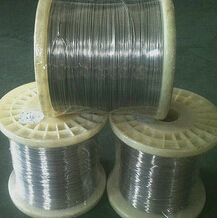
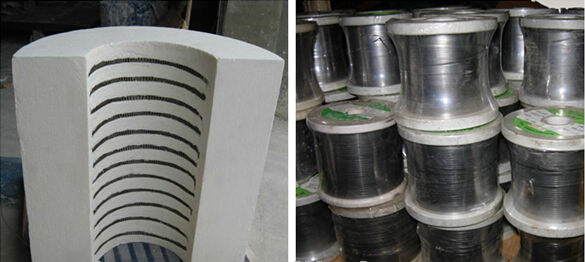
metallic heating elements made from wire or strip in iron-chromium-aluminium FeCrAl alloys or nickel-chromium NiCr alloys for element temperatures between 50-1400 C.
Element types
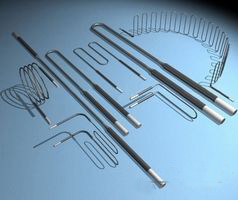
We can manufacture metallic heating elements to any specifications and with short delivery times. Examples of element types are:
Coiled elements (i.e. spiral elements and edge-wounded elements)
ROB – Meander elements
Cartridge elements (i.e. bundle rod elements and cage elements)
Tubothal heating element
Metallic heating element alloys
FeCrAl alloys are characterized by high resistivity and capability to withstand high surface load. They can be used at maximum element temperature of 1400°C.
The NiCr-based alloys are characterized by very good mechanical properties in the hot state as well as good oxdiation and corrosion properties. They are suitable for element temperatures up to 1200°C.
Using FeCrAl alloys instead of NiCr alloys results in both weight-saving and longer element life, leading to considerable cost savings. Compare weight and cost for FeCrAl alloys with NiCr alloys
| Grade | Maximum continuous operating temperature | Resistivity at 20ºC Ω mm2m-1/ 68ºF Ω/cmf |
| FeCrAl alloys | ||
| Cr27Al7Mo2 | 1400ºC | 1.45/872 |
| Cr21Al6Nb | 1300ºC | 1.39/836 |
| Cr25Al5 | 1250ºC | 1.35/812 |
| Cr21Al4 | 1100ºC (2010ºF) | 1.25/744 |
| NiCr alloys | ||
| Cr20Ni80 | 1200ºC | 1.09/255 |
| Cr30Ni70 | 1250ºC | 1.18/709 |
| Cr15Ni60 | 1150ºC | 1.11/668 |
| Cr20Ni35 | 1100ºC | 1.04/626 |
Related guides
- Molybdenum disilicide heating elements
- Silicon carbide heating elements
- MoSi2 vs SiC heating elements guide
- W-type MoSi2 heating elements
- Silicon carbide heating elements complete guide
Why specify with HeatingDriver
HeatingDriver supplies FeCrAl and NiCr resistance heating wires, strips and ribbons in custom alloys and sizes, plus thermocouple wire, with nearly 20 years of export experience and free spec review. Browse our heating elements and furnace parts.
What is the difference between FeCrAl and NiCr heating wire?
FeCrAl (iron-chromium-aluminium) resists higher temperatures (up to about 1400 degC element temperature) and forms a protective alumina scale, while NiCr (nickel-chromium) is easier to work, more ductile and better for lower-temperature or cyclic applications. The choice depends on operating temperature, atmosphere and lifecycle.
How do I choose the wire gauge and resistance for a heating element?
Select the alloy first by maximum operating temperature, then size the wire diameter and length so the cold resistance gives the target power at your supply voltage (P = V^2 / R). Thinner wire runs hotter; wider wire carries more current. HeatingDriver reviews your drawing or spec to confirm the safe surface load.
Can HeatingDriver supply thermocouple wire and custom strips?
Yes. Besides round resistance wire we supply flat strip and ribbon, and thermocouple wire in common pairings (K, J, N, etc.). Alloys, cross-section and spool length are customized to order.
What surface load is safe for resistance heating wire?
Safe surface load depends on alloy, temperature and atmosphere; designs are usually kept within conservative W/cm2 limits to avoid overheating and premature failure. Send your application temperature and voltage and we will size the wire accordingly.